Humidity Caused by Everyday Activities Must Have an Escape Route
Updated: October 2025 — focused on multi-family and apartment applications

Mold is a silent intruder in apartments and multi-family housing. It grows quickly in damp, dark environments, damaging property, increasing maintenance costs, and frustrating residents. Once it becomes visible, it has often already spread behind walls, under floors, and into building materials.
The key to controlling mold isn’t just cleaning it up — it’s controlling the moisture that fuels it.
The Leading Causes of Mold in Apartments
1. High Indoor Humidity
Relative humidity (RH) above 60% provides ideal conditions for mold growth. Bathrooms, kitchens, and laundry areas generate moisture daily, while poorly ventilated units trap it inside.
2. Condensation
Cold surfaces — like windows, mirrors, or exterior walls — collect moisture that seeps into drywall or trim. Over time, this moisture leads to mold growth in hidden corners.
3. Tenant Behavior
In multi-family housing, property managers can’t always rely on residents to run HVAC consistently, use exhaust fans, or promptly report leaks. These gaps give mold the opportunity to take hold.
4. HVAC Limitations
Standard HVAC systems are designed to manage temperature, not humidity. In humid climates or tightly built apartments, they often leave behind excess moisture, especially during shoulder seasons when cooling loads are light.
Why Mold Is a Bigger Problem in Multi-Family Housing
Unlike single-family homes, multi-family buildings face compounded risks:
- Shared walls and plumbing allow moisture problems in one unit to spread into others.
- High occupancy turnover increases the chance of unnoticed or unresolved moisture issues.
- Small bathrooms and kitchens concentrate moisture in tight spaces.
- Portable dehumidifiers are unreliable — tenants may unplug them, neglect to empty buckets, or move them around.
For property managers, this creates recurring mold complaints and costly repairs.
Eradicating Mold: Focus on Prevention
Cleaning visible mold is only a temporary fix. Spores remain airborne and will regrow if moisture levels stay high. The only long-term solution is to control indoor humidity.
EPA & CDC Guidance
- EPA: Keep indoor RH below 60%, ideally between 30–50%, to minimize mold growth.
- CDC: Aim to keep indoor humidity ≤50% where possible.
Meeting these standards requires more than ventilation alone — it requires permanent, automatic dehumidification.
Permanent Dehumidification for Apartments
Innovative Dehumidifier Systems (IDS) offers solutions designed for apartments and multi-family housing:
- IW-25-5 In-Wall/On-Wall Dehumidifier
- Discreet installation, blends into the living environment
- Quiet operation, tamper-resistant design
- Continuous drainage — no buckets to empty
These systems provide consistent humidity control without relying on tenants — protecting property investments and reducing maintenance calls.
The Bottom Line
Mold in apartments isn’t just unsightly — it’s a symptom of uncontrolled humidity. For property managers, developers, and owners, relying on tenants or temporary fixes isn’t enough.
The solution is permanent, in-wall dehumidification that runs automatically, maintains safe humidity levels, and stops mold before it spreads.
Find a Distributor →
Talk to a Solutions Engineer →
References
- U.S. Environmental Protection Agency (EPA): Mold Resources
- U.S. Centers for Disease Control and Prevention (CDC): Mold Basics
A Multitude of Causes

What causes mold in apartments? Excess moisture can originate from almost anywhere, and that’s what gives mold its start. However, growth happens when the high relative humidity (the presence of excess moisture in the air) in an apartment stays consistently at or above 60%. When a room starts to smell musty, mold has become a problem. In an ideal situation, tenants would inform the landlord of the concern immediately so damage can be mitigated, but that often doesn’t happen.
In climates where humidity stays high, understanding that high relative humidity leads to condensation is key. Condensation occurs when moisture in the air turns into water on a cool surface. The surface temperature at which this occurs is called the dew point. The dew point—and thus mold—can be controlled by properly managing room temperature and relative humidity.
Mold needs nourishment and the right conditions to live. Without a food source, the appropriate temperature, oxygen, and adequate moisture, mold will be killed off. Blasting the AC continually can help an HVAC system reduce moisture in the air thus eradicating mold, but at what cost? There is no guarantee it will dehumidify regardless of how low the thermostat is set. And, overusing your HVAC to reduce humidity will result in wasted energy, higher electric bills, shorter life spans of the HVAC unit, and an overchilled home. But is there a better way to prevent mold in an apartment while keeping the space comfortable? Yes, there is!
Taking Action Against Mold

Whole-Home dehumidifiers can effectively remove moisture from an entire home with a noise level just above that of a kitchen refrigerator, but how effectively do they work in an apartment? If installed in the wrong location, there may be tenant complaints about heat displacement. These units are ducted into the HVAC system and only work when the HVAC is running. Since HVAC systems run efficiently in short cycles (turning on just to meet the temperature settings, then turning off again), whole-home dehumidifiers don’t run continually and can be as inefficient at controlling humidity as using an HVAC system alone.
Portable dehumidifiers, while less costly up front, are also less energy efficient and can quickly run up a tenant’s electric bill. They are noisy and can pose a safety hazard if not used properly. This option also requires tenants to manually empty the tank when full, which is messy, inconvenient, easily forgotten, and adds an injury risk for tenants to slip on wet floors in the process. Relying on tenants to maintain portables makes them a less than ideal permanent solution.
A Sure Winner From Innovative Dehumidifier Systems
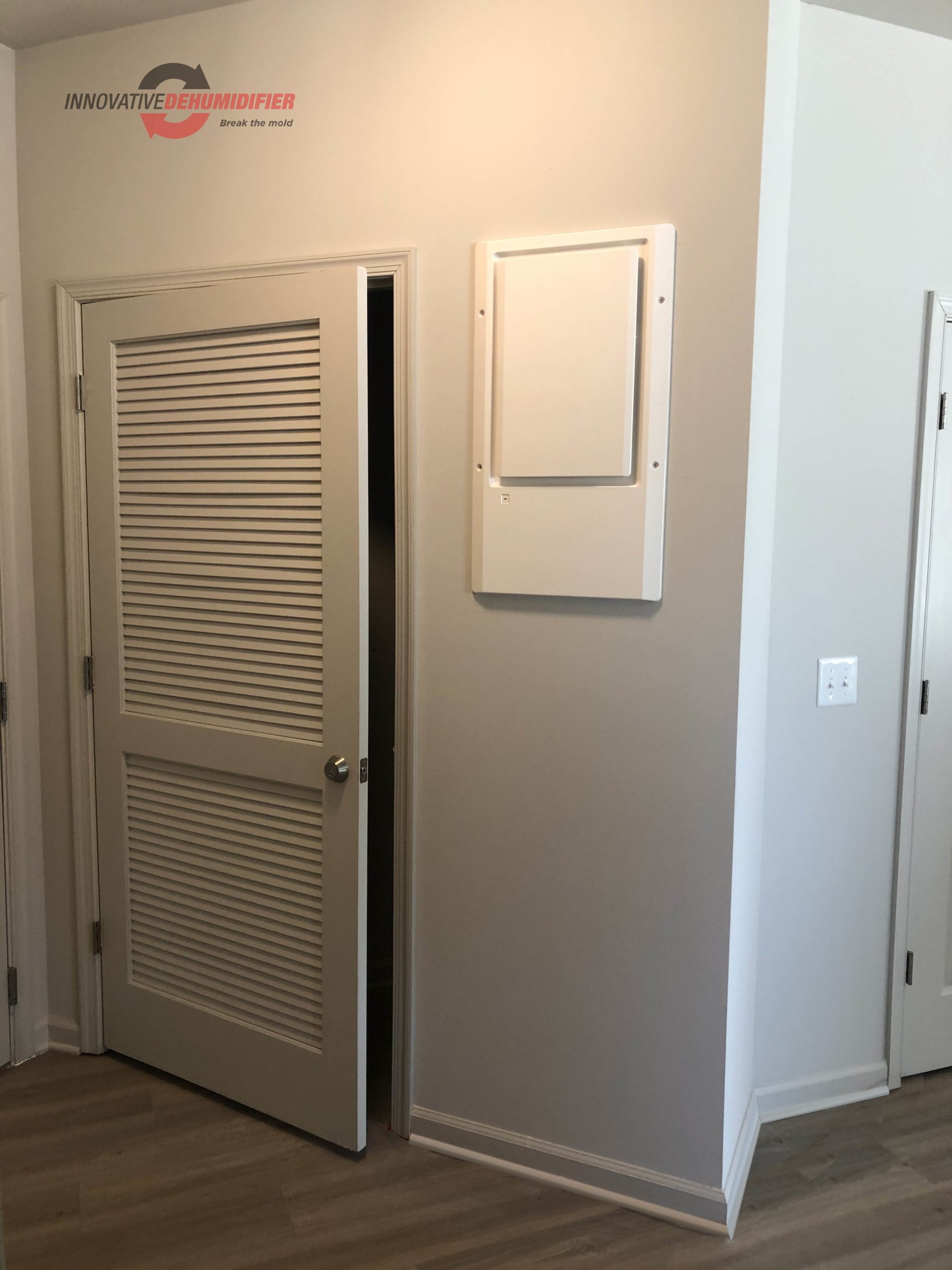
One solution specifically designed for eradicating mold in apartments is the award-winning, energy-efficient IN Wall/ON Wall IW25-5 dehumidifier by Innovative Dehumidifier Systems. The IW25-5 puts apartment humidity control directly in the hands of landlords and property owners. Created to provide moisture removal daily, the built-in dehumidifier system includes a tamper-proof cover that can only be removed using a special tool. The IW25-4 can be quickly installed inside an interior wall between existing studs or hung directly on a wall. It operates independently of the HVAC system to condense and remove moisture in apartments quietly and efficiently. The system uses gravity to drain directly into existing plumbing, and when needed, an optional internal condensate pump (purchased separately) is installed inside the unit to redirect collected condensation.
For landlords and tenants alike, the IW25-5 wins the battle against mold and its causes in apartments.